Solve the Case Review
Who the suitcase is for, how the build holds up, and whether five plays earn the price.
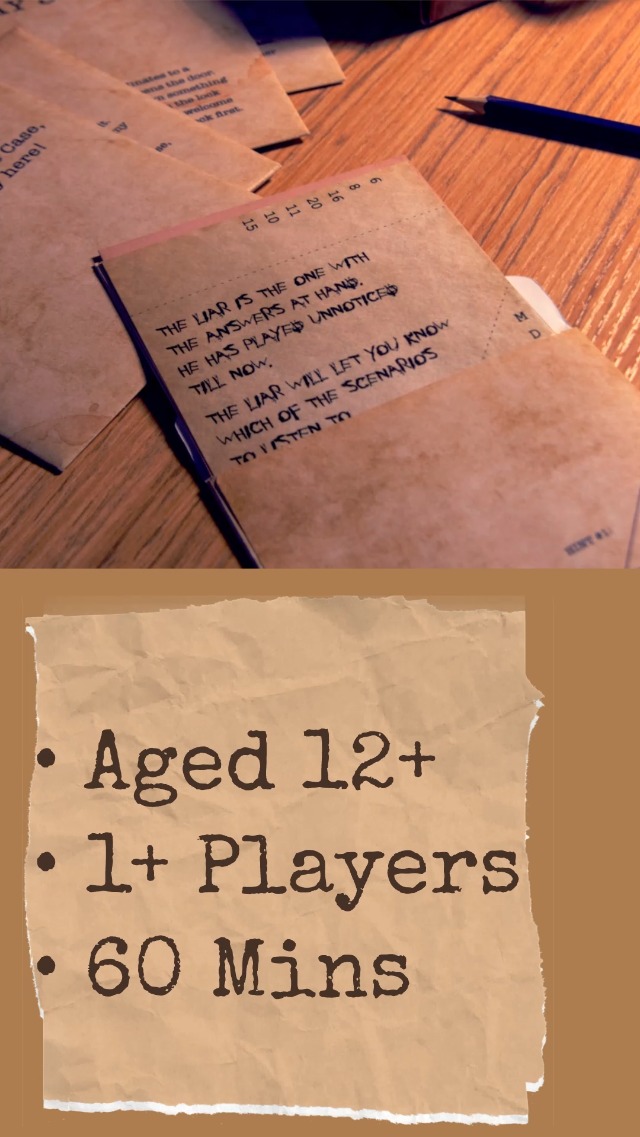
Solve the Case is a physical suitcase escape room from Fizz Creations (The Games Room), not a video game and not a Roblox experience. In the fiction, airport security finds a sticker-covered piece of luggage and you work out who owns it. On the table you get a printed cardboard case, five sealed play envelopes, an instruction sheet, and an answer sheet. The box is for ages 12 and up, for one or more people sharing that single case, and for about sixty minutes or more per play. It reached retail in 2023 and is still a finished tabletop product: no patches, no lobby, no download.
This review stays spoiler-light. It covers who enjoys the campaign, how the object is made, how the five plays are paced, the Play 4 coin complaint that shows up again and again in community comments, and whether a typical price near twenty dollars makes sense next to a booked venue room. It does not print codes, names, ships, or the finale. The official Fizz Creations trailer is embedded in the middle of this article—the page stores the real video id, and the site places that one player after the audience section—so you can see the case before the build notes.
Who it is actually for
Three groups get the most from the suitcase, and a fourth can finish it alone.
Families with teens, or with younger puzzle fans paired to an adult, can treat each envelope as one evening. You stop on a win and still have sealed chapters left. Hosting rhythm, lighting, and how to keep phones off the table are written up on Family and Date Night. Couples use the same structure as date night when a film feels passive: you talk, you pass cards, and you share one object both people can see.
Small teams use it as a concrete icebreaker. A work group, club, or friend circle (still respecting the 12+ guidance) can split a reader, a case handler, a scribe, and a single answer checker. That format is covered on Team Building. Solo play is legitimate. Nothing on the case requires a second pair of hands, though a second pair of eyes helps on fiddly alignments. This is local play around one suitcase.
Skip it, or at least borrow it first, if your group melts down the moment a step feels unfair, or if you wanted a luxury wooden puzzle box. The design expects red herrings, and one chapter is widely called under-clued. The official trailer sits next, before the notes on cardboard, stickers, and what the price actually buys.
Build quality on the table
The case is cardboard dressed as vintage travel luggage. Printed stickers, panels, locks, scratch areas, mazes, and a 3D interior you actually open are the product. The story talks about leather; the object in your hands is not a leather briefcase and it will not survive being sat on. Treated as a board-game component, the production is cheerful and surprisingly dense for the shelf it sits on. Cards are ordinary escape-room stock: readable under a good lamp, easy to crease if someone folds in a hurry.
What impresses is interaction density. You are not solving a booklet of riddles while a pretty box stays closed. Cutouts line up with art on the case, folds reference shapes printed inside, and earlier envelopes stay relevant later. That is the portable 3D escape-room claim made literal. For a gift that looks like luggage and plays like a campaign, the first impression is strong.
What does not impress is durability theater. Scratch panels are one-way. A drink ring on a sticker is permanent. Store the case flat, keep snacks off the interior, and do not let a keen helper test a later envelope. Setup habits, the one-checker rule, and why you keep finished plays are in Getting Started. Relative toughness of each chapter, still without the solutions, is ranked on the Difficulty Tier List.
Five plays, and how the hours feel
You must play in order from 1 to 5. Each envelope is its own sitting of roughly an hour, sometimes longer if the table argues or if a fold will not sit. Five plays means five evenings for most households, or one long Saturday if you insist on a marathon. Plan buffer. The sixty-minute mark on the box is a target, not an automatic failure, unless your group wants competitive pressure.
Pacing inside a play is classic escape-room shape: a gentle on-ramp, a messy middle, and a final answer you confirm on the sheet before the next envelope comes out. Early plays teach you to trust the case as a tool. Middle plays add ciphers, overlays, and identity work. Later plays call back to material you were told to keep. Throwing Play 1 away is how groups invent difficulty the designer did not write.
A healthy cadence is one play, a short debrief, and a hard stop. Chaining all five while tired makes the back half feel worse than it is, because the later chapters ask for precise deduction after your attention has already been spent on stickers and folds. If you only remember one hosting rule, stop on a solved envelope. The story of the lost case is built to survive a week of gaps; it is not built to survive someone opening every packet in the first ten minutes.
Play 4 and the coin complaint
Community consensus is blunt, and this review agrees with it. Play 4 contains a coin-rotation step that a large share of players call confusing, fiddly, or poorly explained. Other work in that same envelope—word-grid identification and a shipping lead—is generally treated as fair. The coins are the part people remember with irritation. Comment threads under the official walkthrough repeat the same frustration. This is not a loud minority inventing a problem. It is the complaint you should expect before you buy.
That does not sink the whole product. It means you should agree, before that envelope opens, what stuck means. Hints on the back bottom of the envelope exist. A ten-minute break exists. Looking up a full solution is a choice, not a moral failure, once the table has genuinely tried. The Play 4 walkthrough is there for that moment and is labeled so you can stop before the final line. Do not open it on the first night, and do not let one annoyed person narrate the answer to everyone else.
Groups who like spatial puzzles sometimes shrug at the coins. Groups who came for wordplay often do not. Either way, budget extra patience for that sitting, especially on a date or a family night where a sour half-hour can color the whole campaign. The rest of the five plays do not share that reputation. Play 1 is the usual onboarding. The finale asks for logic more than for rotating a prop until it feels arbitrary.
About twenty dollars versus a booked room
Street price for the full suitcase often sits near $20 at major retailers, with normal swings for region, sale, and stock. Confirm the live price on the seller page. This wiki does not take orders. Starting points are collected on Where to Buy. Product history, the 2023 release, reprints, and how the smaller Mini line differs from this five-play case are on Updates.
Compare that to a venue escape room. A commercial room is usually a per-person ticket, a fixed slot, a host, and a set you cannot replay next Thursday because you already know it. Solve the Case cannot match set dressing, lighting design, actors, or the social thrill of a locked door. It also does not need a booking, a drive, or a minimum headcount. For about the price of a cheap takeaway you get five separate hour-long sessions you can pause between school nights or workdays. On dollars per puzzle-hour, the suitcase wins easily. On spectacle, the venue wins. Buy it as a tabletop campaign, not as a substitute for a birthday room.
Replay value after you know the answers is low, which is normal for escape products. The value is the first pass, shared. Gifting a solved copy is a bad gift. Gifting a sealed copy to a household that likes talking through clues is one of the better uses of a twenty-dollar toy-aisle puzzle.
How to use the rest of this wiki
Start with rules, not answers. Getting Started covers unboxing and the lockout: one checker, a wrong final locks that person out of the current play only, and they return when the next envelope opens. Tips and Hints stays spoiler-light if you want process help without codes. The Guides Hub indexes every walkthrough for the moment you are truly stuck. Each play page carries one official video in the middle of the article, the same pattern as the trailer on this page.
Verdict
Solve the Case is an easy recommendation for families, couples, and small teams who like talking through a prop more than optimizing a heavy strategy game, and who can forgive one famously annoying coin step. The cardboard case looks like a gift and behaves like a five-session campaign. At a typical retail price around $20 it is one of the better try-escape-rooms-at-home objects on a general-store shelf, provided you keep later envelopes sealed and you do not expect leather, actors, or a perfectly smooth difficulty curve. If your table quits the moment a puzzle feels unfair, borrow a copy or agree on hints in advance. Everyone else should clear a lamp-lit table, open Play 1 only, and give the lost luggage an honest hour before judging the whole suitcase.
Frequently Asked Questions
Quick answers for detectives stuck on the case.
Who is Solve the Case best for?
Families, couples on date night, and small teams sharing one suitcase. Ages 12+, with 1 or more players in the same room. Solo play also works.
Is it worth about $20 compared with a venue escape room?
On hours of puzzles per dollar, yes—five plays at roughly an hour each for a typical retail price near $20. A venue still wins on spectacle, hosts, and set dressing.
Why do players complain about Play 4?
Community consensus singles out the coin-rotation step as confusing or under-clued. Other parts of that play are generally considered fair. Agree on hints before you open the envelope.
How long is the full suitcase?
Five sequential plays, about 60 minutes or more each. Most households do one play per sitting rather than all five in a single afternoon.
Does this review spoil the answers?
No. It avoids codes, names, and finale details. Use Getting Started and Tips and Hints first; open a play walkthrough only when the table is actually stuck.